
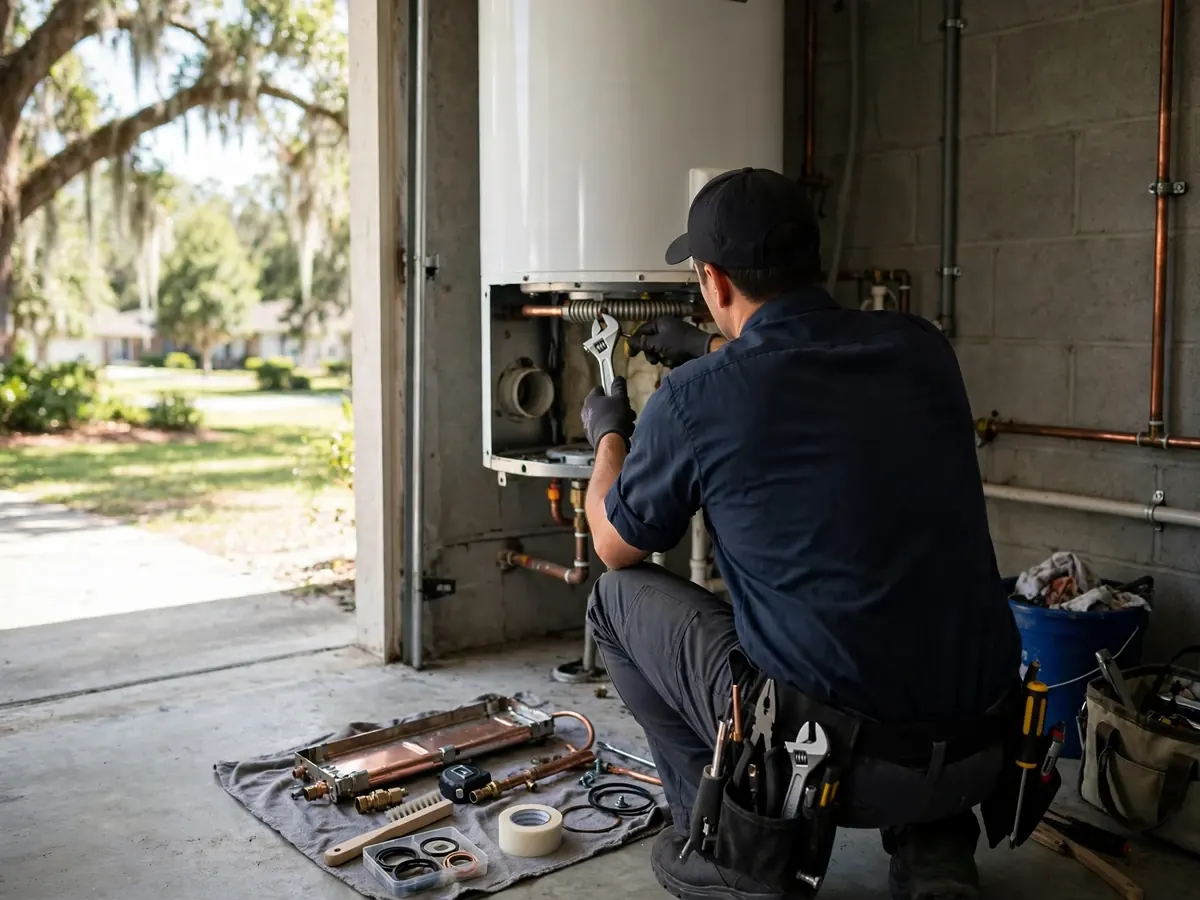
Safety First
Handle these before anything else.
- Gas smell. Leave the house and call the gas utility from outside.
- Water on the floor. Shut off the cold supply and the power or gas.
- Scorch marks or a hot panel. Turn off power and call.
- Dripping relief valve. Do not plug it. Call for service.
Checks for Electric Tanks
| Check | What to look for | Next step |
|---|---|---|
| Breaker | Tripped or off | Reset once. If it trips again, call. |
| High limit reset button. | Red button on the thermostat panel. | Press once with power off. |
| Thermostat setting | Set too low | Raise to a safe setting. |
| Heating elements | No heat after power checks. | Needs testing by a plumber. |
Want a Plumber to Look at It?
Call the 24/7 line, any hour.
Checks for Gas Tanks
| Check | What to look for | Next step |
|---|---|---|
| Pilot light | Out or flickering | Relight per the label if no gas smell. |
| Gas supply valve | Handle turned off | Open it fully |
| Thermocouple | Pilot will not stay lit. | Needs replacement |
| Venting | Backdraft or soot | Call a plumber |
Lebanon Note: Cold Mornings and Sediment
Willamette Valley winters mean colder incoming water, which makes a marginal heater struggle sooner. Lebanon's published reports list a pH average near 7.7 but no hardness figure we can quote, so test your tap or ask the City. Hard water builds sediment, which is a common reason hot water runs out early.
A tank past 10 years old with sediment noises and falling hot water is a replacement candidate, see water heater replacement.
Relief valve and gas safety rules follow the Uniform Plumbing Code (UPC) as adopted in Oregon, and the label on your heater lists the manufacturer's guidelines for resets and pilots.
When to Call Right Now
Call at once for a leaking tank, a gas smell, a relief valve that keeps discharging or a heater that repeatedly trips the breaker. Our 24/7 line is answered any hour. For tankless units with error codes, see tankless water heater service.
We serve Lebanon, Sweet Home and Scio. A clear price comes before work starts.
A Ten Minute Diagnosis Sequence
Work through these in order and write down what you find. It makes the phone call faster.
Check other hot taps
If only one tap is cold, the problem is the fixture or its supply line, not the heater.
Look at the heater label
Note the fuel type, size and age. Plumbers ask for these first.
Check the breaker or gas valve
A tripped breaker or a closed gas valve explains many outages.
Listen to the unit
Popping, hissing or silence each point to different faults.
Feel the outlet pipe
A warm outlet with cold taps suggests a mixing or distribution fault.
Why a Heater Quits in the Middle of Winter
Heaters often fail when demand is highest. Cold incoming water forces elements to work longer and puts more strain on a tired thermostat or a worn burner. A tank that limped through summer may give out on the first frost, which is why the cold months generate so many calls.
That does not mean every failure needs a new tank. A failed element or thermostat on a younger tank is a modest repair. The age of the unit and the location of the fault together decide the right move, and a plumber can tell you in a short visit.
Questions to Answer Before You Call
Having these ready speeds up the visit.
- Is it gas or electric? The label or the fuel line tells you.
- How old is the tank? The serial number often encodes the year.
- Is there any water around the base? A leak changes the urgency.
- Did anything happen first? A power surge, a storm or recent work can point to the cause.
Gas Versus Electric: Which Faults to Expect
Electric tanks usually fail at the elements, thermostats or the high limit switch. Gas tanks fail at the pilot assembly, thermocouple or gas control valve, and venting problems can trip safety shutoffs. Each fault has a different cost and a different level of safety concern.
Gas faults involving the burner or venting should be left to a plumber. Electric faults involving wiring should be left to a pro too if you are not comfortable working near live power.
Keeping It From Happening Again
Flush the tank once a year to clear sediment, check the anode rod every few years and keep the area around the heater clear. Test the relief valve gently each year by lifting the lever briefly. If it does not reseat, call a plumber.
No Hot Water: What to Check: Local Questions
Common causes are a tripped breaker, a failed element or thermostat, or a pilot problem on a gas tank.
Once. If it trips again, there is a fault. Call a plumber or electrician.
Often yes, following the label, if there is no gas smell.
A failed lower element, sediment or an undersized tank can cause it.
It depends on age and the failed part. Past 10 to 12 years, replacement often makes more sense.