
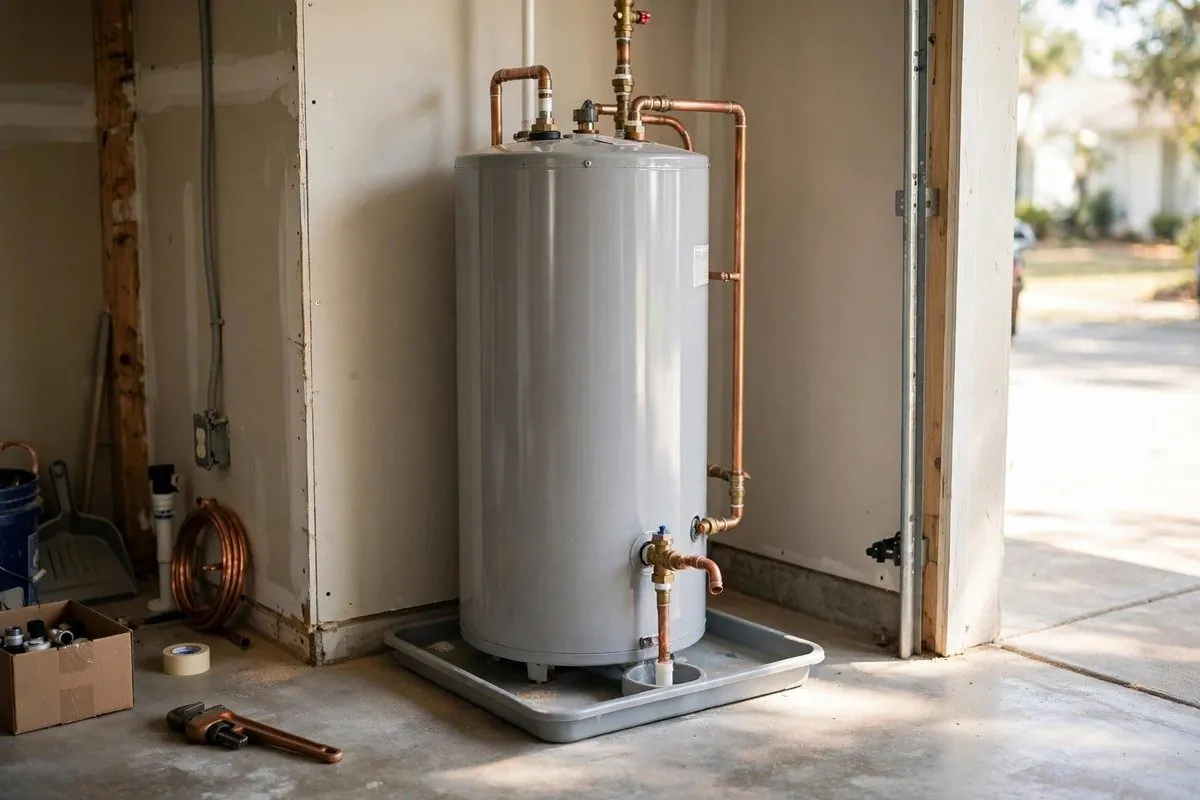
A Failed Tank Is Time Sensitive
A tank that leaks from the body has finished its life. Steel liners corrode over years, and once a seam opens, water escapes faster than any patch can hold. The longer it runs, the more floor, wall and stored belongings it reaches.
The 24/7 line is answered at any hour. We ask where the leak is, whether the unit is gas or electric and how old it is, then arrange the visit. Same-day appointments are offered when the schedule allows.
How a Replacement Visit Runs
Most swaps follow the same order, though gas units add venting and gas line steps.
Drain and disconnect
The old tank is shut off, drained and disconnected from water, gas or power.
Set the new unit
The replacement is placed with a drain pan where the space allows.
Connect and vent
Water lines, venting and gas or electrical connections are made and checked.
Add safety parts
A relief valve, discharge line and expansion tank are added where needed.
Test and show you
The plumber fires up the heater, checks for leaks and shows you the shutoffs.
Choosing the Replacement Type
The right unit depends on household size, fuel and space. This comparison covers the usual choices.
| Type | Good fit | Watch for |
|---|---|---|
| Standard gas tank | Homes with gas service and a vented space. | Venting and combustion air requirements. |
| Standard electric tank | Homes without gas, easy to install. | Higher running cost per gallon heated. |
| Tankless | Small spaces, steady use by smaller households. | Higher upfront cost and scale upkeep, see tankless. |
| Hybrid heat pump | Electric homes wanting lower power use. | Needs air space and a condensate drain. |
Ask which tank size fits your fixtures. An undersized unit will leave a family showering in cold water.
Need a Replacement Quote?
Call and give us the age, fuel and size of the old tank. We will tell you what to expect.
Things to Check Before You Approve a Replacement
- Does it fit the space? Measure height and clearance for the new tank and its venting.
- Is an expansion tank needed? Closed plumbing systems often require one to absorb pressure changes.
- Will the old parts be reused? Flex lines, valves and vent connectors often should be replaced.
- Is a permit required? Ask the City of Lebanon Building Division which edition of the Oregon Plumbing Specialty Code applies.
- What is the warranty on the unit? Warranties differ by manufacturer and by tank or parts, so ask for the paperwork.
Older Homes and Hidden Surprises
Lebanon has homes from many eras, from early twentieth century houses near downtown to newer subdivisions. A water heater in an older home may sit in a crawlspace or a tight closet with outdated venting. Galvanized supply pipe in older houses can corrode at the heater connections, and a swap sometimes reveals it.
If we find a problem, you hear about it with a price before extra work starts. For widespread pipe corrosion, our repiping page explains the option.
What Affects the Cost of Water Heater Replacement
Prices vary because no two installs match.
The price is given before work starts. Call (503) 974-3329 to talk it through.
Water Heater Replacement Questions in Lebanon, OR
Yes. The emergency line is answered 24/7, including nights, weekends and holidays, and same-day appointments are offered when the schedule allows. Call (503) 974-3329 and describe what you see.
Many tank units last about 8 to 12 years depending on water quality and upkeep. A unit past 10 years with leaks is usually a replacement candidate.
It can be a good move for smaller households or tight spaces, but it costs more and needs gas and venting that suit it. See tankless water heaters.
Many homes with a closed plumbing system need one. A plumber checks your pressure and the setup before deciding.
Replacement swaps a failed unit. A first-time install on a new line is covered on our water heater installation page.
Yes. We run service to Sweet Home, Scio and Brownsville.
Codes and Sources
Expansion tanks, relief valves and venting are governed by the Oregon Plumbing Specialty Code, which is based on the Uniform Plumbing Code (UPC), and by the manufacturer's installation guidelines.