
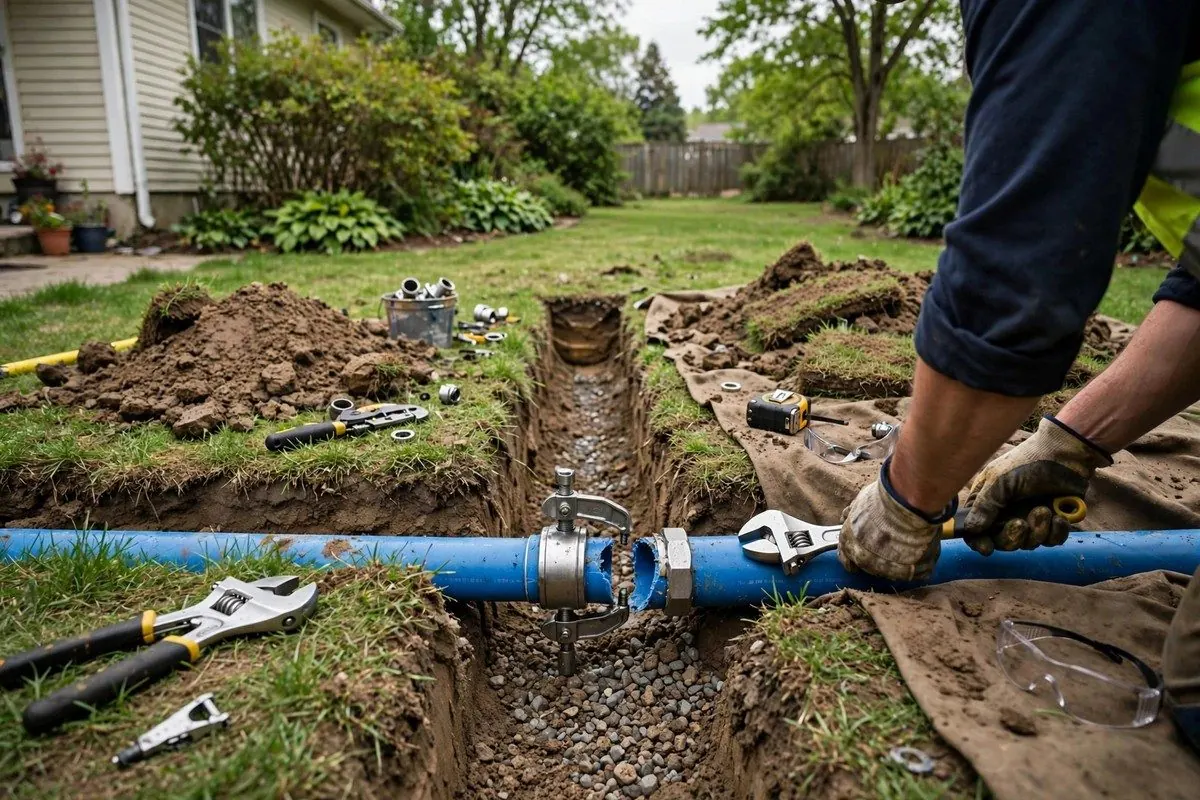
Signs Your Service Line Is Failing
A service line fails slowly or all at once. Slow failures show up as a wet strip of lawn that never dries, a hissing near the meter, falling pressure, or a meter that spins when everything is off. A sudden break sends water to the surface and may wash out soil or pavement.
Because the line is buried, a small leak can run for months. Catching it early keeps the repair small, so treat any unexplained wet spot or bill increase as worth a call.
What Could Be Wrong Underground
Pinhole leaks
Older copper and galvanized pipe corrode from the inside and wear through in spots.
Joint or fitting failure
A coupling or connection loosens with ground movement.
Root or frost damage
Roots and winter freeze can crack pipe or crush a section.
Damage from digging
Fence posts, landscaping and utility work can nick a buried line.
Spot Repair, Trenchless or Full Replacement
The choice depends on how much pipe is damaged and what lies above it.
Spot repair fits when
- A single section is damaged.
- The pipe elsewhere is sound and modern.
- Access is open, such as lawn or bare soil.
Full replacement fits when
- The pipe is old galvanized or failing in many places.
- Repeated repairs have been needed.
- Pressure is poor along the whole line.
Water Surfacing in the Yard?
Call the 24/7 line. Shut off the main first if you can.
Soil and Season in Lebanon
Lebanon sits near the South Santiam River on valley soils that stay wet through the rainy months. Wet clay shifts as it swells and dries, and that movement stresses buried pipe over years. Winter lows can also freeze shallow lines at spots with little cover, such as near a meter box or hose bib.
In older neighborhoods around downtown, original galvanized service lines are not unusual. They corrode from the inside, which also hurts pressure. A new line in modern pipe fixes both problems, and our repiping page covers the plumbing inside the house.
Lebanon Note: Where City Responsibility Ends
The City of Lebanon supplies treated water from the South Santiam River. The city generally maintains its side up to the meter, and the line from the meter to your house is usually the owner's to repair. Confirm the exact boundary with the City before work, and call before you dig so buried utilities are marked.
Service lines fall under the Oregon Plumbing Specialty Code, based on the Uniform Plumbing Code (UPC), and under the City of Lebanon's own water rules, so ask the City before you replace a line.
Before the Plumber Arrives
- Shut off the main. Close the valve at the meter or where the line enters the house.
- Mark the wet spot. A flag or stake shows us where to start.
- Keep people and pets back. Soaked soil can cave and mud hides holes.
- Photograph the damage. Photos help if insurance may be involved.
What Affects the Cost of Water Line Repair
The depth, length and surface drive the price.
You get a clear price before work starts. Call (503) 974-3329 for yours.
Water Line Repair Questions in Lebanon, OR
Yes. The emergency line is answered 24/7, including nights, weekends and holidays, and same-day appointments are offered when the schedule allows. Call (503) 974-3329 and tell us what is happening.
The owner typically maintains the line from the meter to the house, while the City handles the supply side. Confirm your boundary with the City of Lebanon.
Often a spot repair needs only a small excavation. Full replacement may use a longer trench or trenchless methods when conditions allow.
Look for the meter box near the street and a valve at the house where the line enters. Test it so it turns when you need it.
No. Low pressure can come from a failing regulator, clogged fixtures or a corroded line. A pressure check narrows it down, see leak detection.
Yes. See Brownsville and Scio for local details, including the rules on service lines in each town.